Jane Porterfield, Nest Schools
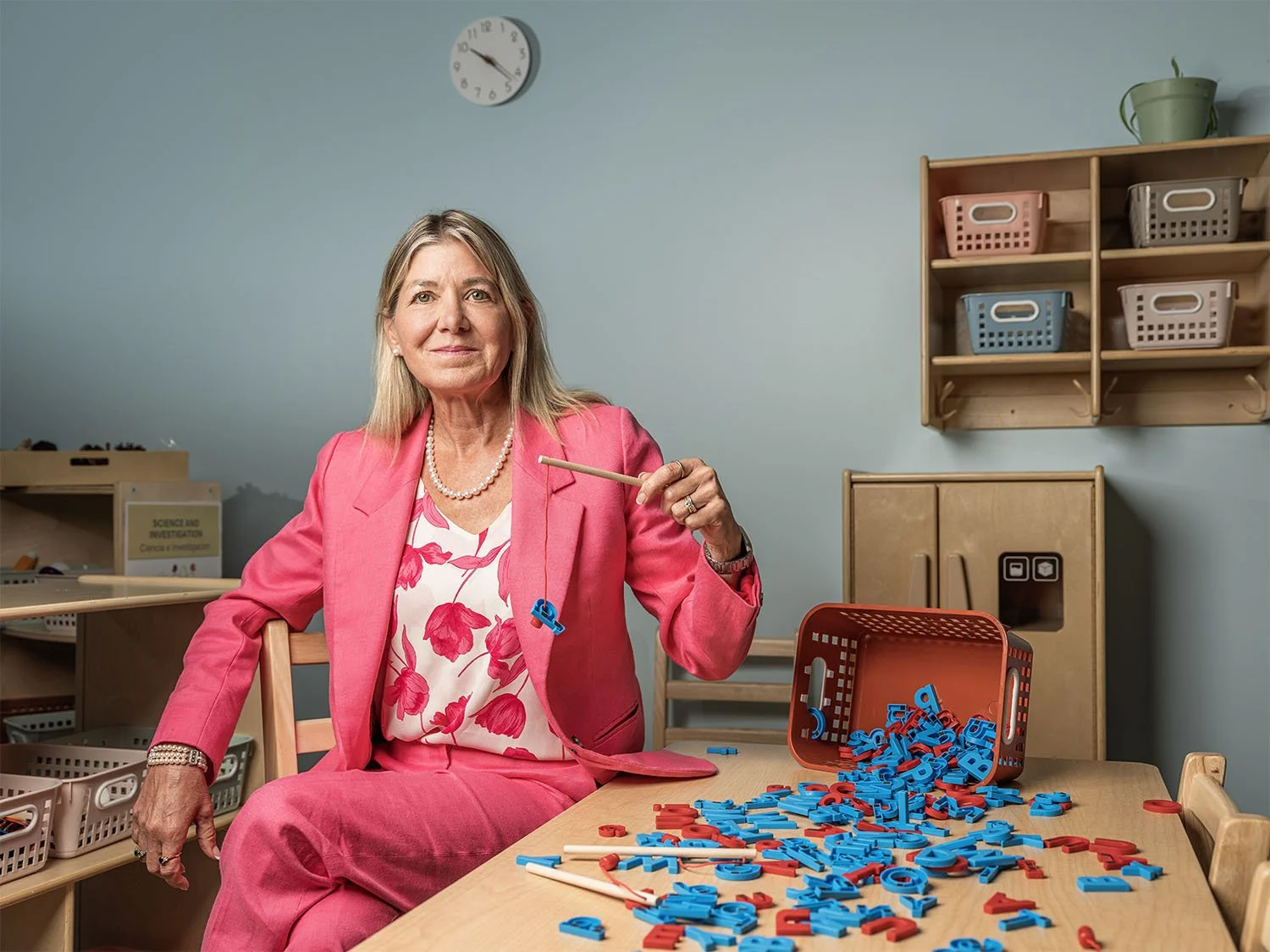
Meet Jane Porterfield, a visionary entrepreneur and early childhood education advocate whose career spans nearly four decades of transformative leadership. As the Founder and Co-CEO of The Nest Schools, and previously the Founder and Owner of Educational Playcare, Jane has redefined what quality childcare looks like in Connecticut and beyond. Her journey began with a master’s degree in Early Childhood Education from the University of Saint Joseph, and evolved into a lifelong mission to create nurturing, play-based environments where children thrive emotionally, socially, and intellectually.
Under her leadership, Educational Playcare (now, Bright Path) grew to serve hundreds of families across the Greater Hartford area, offering innovative services that supported both children and their busy parents, from on-site enrichment programs to thoughtful arrangements that offered conveniences like haircuts and swim lessons. After selling the company in 2019, Jane and Gerry (her husband and business partner) launched The Nest Schools in 2020, bringing their passion and expertise back to the community with a renewed focus on wellness, kindness, and research-backed curriculum.
Jane’s work continues to shape the future of early education, blending entrepreneurial spirit with heartfelt dedication to children’s growth and family support. “We feel like all the children in our program should be able to participate in every aspect of our program,” she says, reflecting her deep commitment to inclusivity and holistic development. Her legacy is one of excellence, innovation, and an unwavering belief in the power of play.
Here’s more on what we can learn from this week’s Poise and Purpose spotlight:
For those meeting you for the first time, tell us who’s impacted by the work that you do?
“The work impacts children and staff indirectly. Over the years, I've worked with thousands of children, and it's fun now because even children who were students come back as parents. But more than that, it's about the staff. I really love mentoring young women, especially. Many started working part-time when they were in high school, or even women who came to it not really knowing what they wanted to do. They move up through the ranks and end up directing their own school or going off into something else. I always like to watch the growth - to see what people's talents are and how I can nurture them and get them in the right direction.”
What’s your personal connection to this work?
“I didn’t have access to a lot of career counseling options at that time, so I had a really limited experience of different career paths. My mother was a teacher, and my grandmother was a teacher. I always loved little kids. I babysat from a very young age and taught church nursery school. I initially thought I wanted to be a high school English teacher because I loved literature and reading. After going through undergraduate studies and teaching, I realized the students weren't really that interested.
It was at the very beginning of formal child care when I got a job working with two-year-olds at St. Joseph’s in West Hartford. I absolutely loved it. I hadn't even known this was a potential career path. While working there, I decided to get my master's degree in early childhood education. But I soon realized you couldn't support yourself doing that kind of work, so I started looking at different options. That's when I decided to open my own school, knowing absolutely nothing about what I was doing. I had the building built out, which I didn't really know how to do. There were a lot of firsts, and I learned by doing and figuring things out. I started very small and learned everything - payroll, bookkeeping, everything - with no business background at all. I'm someone who, if you give me an instruction manual, will read it front to back. But here, I had to build my own instruction manual, and it took me a while to figure out what I was doing."
While rewarding, purpose-driven work can also require significant energy from us. Do you have a self-care routine that helps you maintain balance?
“I’ve gotten to be good at that. First of all, I get up very, very early in the morning (like with the birds). Because I do my best work in the morning. I meditate every day. I exercise, and I go to the gym every other day. I walk. I journal. I spend time outside every day.
I’ve gotten much better at building that. I think it’s more important now than ever. I was the center director of my first school for 22 years, and that was when my kids were little and all that stuff. I was always, always in a rush - complete and total rush. Now, I really try to slow down. I’ve not mastered it yet, but I’ve gotten better. It's taken me only the last couple of years to figure out how quickly I was doing everything.
I tend to be overly critical and good at seeing what's wrong in places. So now, I'm trying to step back and see what's right. Fiona (her dog) has been very good for me. Before, in our last house, we had a lot of land and an invisible fence there. We always had big dogs, and they could go out by themselves. She’s the first dog I’ve ever had to walk, and that’s been good because she sets the pace, which isn't always very speedy. And she decides where she wants to go.” (smiles)
Where have you drawn inspiration from throughout this journey?
"I really didn't have many mentors when I started. I mean, I did a lot of research and joined professional affinity groups, but I didn't really know other women who were leading companies. There weren't nearly as many resources then as there are now.
I really think that early childhood is such an incredibly important, precious time for children. My inspiration comes from wanting to keep childhood pure, so that there aren't all these outside influences pressuring children to achieve. I want children to be curious and excited about learning, not feeling the need to be perfect. I've noticed that children are so over-scheduled now, and the more stimulation they get, the more they seem to need.
I always read a lot of business books and research about child development and curriculum. But it was really very much a learn-by-trial approach. I don't think that's the easiest way to do things, but I've learned so much from the people I've worked with over the years - especially the staff who worked for me.
My mother and grandmother were both teachers, which certainly influenced my path. But mostly, I've drawn inspiration from the children themselves and the potential of early education.
We're their first experience outside of their house. It's such an honor and a privilege, but also a huge responsibility. I never lose sight of that responsibility. My goal is to provide an environment that allows children freedom to explore, with teachers acting as facilitators. I really believe in play-based learning - the basics of early childhood education that people got away from for a while.
I've always loved watching people's talents emerge and helping them find their way, both with children and with the young women who have worked with me over the years. Watching staff grow from part-time workers to directors of their own schools has been incredibly inspiring."
Has there been a particular challenge in your own life, where looking back now, you realize it was a pivotal moment in your own growth journey?
"We had decided to sell Educational Playcare after 35 years, and it was a relatively sudden thing. I thought I was going to be doing this forever. I mean, I loved every part of it. But it was a good time. We had a good opportunity to sell the business. My husband had some health issues - nothing major, just back surgery - and it was at the point where our kids were working in the business, but we didn't want to force our dreams on them.
We were trying to determine what was the right direction. We made the decision to retire. We sold the business at the end of 2019, but immediately started wondering, 'What would we want to do?' I missed it. Neither of us knew what to do with ourselves. This had always been our life. I started working when I was 14 and never stopped. Even when my kids were born, I took two weeks off and then took the office with me. So suddenly not working was completely foreign.
We started a national affinity group for childcare owners. It was during the COVID time, everyone was struggling. Someone we knew needed help. So at first we thought, we'll go in with them and work together, but then it just grew. We gathered a bunch of people whom we had known over the years - who were other entrepreneurs, everybody in childcare. We gathered a group of seven or eight people who had been friends over the years and said, 'Hey, want to start a really cool childcare company?' and everyone said, 'Yeah, that sounds like fun.' And that's what we did. It's been growing very rapidly these first couple of years.
We'd always grown our business by stretching and doing what we could. Now we could do things by design, which was exciting. The last time around, I was in business for 10 years before we had an ops manual. I thought, wouldn't it be cool if we actually started with one? It was just fun because we were drawing from our collective skills and people from all different parts of the country. We had people from Georgia, Virginia, North Carolina, Ohio - and we gathered our whole leadership team that way. Today we have 60 schools and are in 11 states."
Lastly, what advice would you offer the woman with a whisper in her heart to lean deeper into her power?
"I think it's really important to have a plan and do research. Have a plan, and then once you have that plan, be ready to throw it out the window and pivot in another direction. Don't be afraid of change, and don't be afraid that you don't know what you're doing, because you can figure it out. Everything is figure-out-able.
When I started, I didn't really know other women who were leading companies. There weren't nearly as many resources then as there are now. I always read a lot of business books and research about child development and curriculum. But it was really about learning by trial and error. While that might not be the easiest way to do things, I learned so much from the people I worked with and who worked for me over the years.
My advice would be to create a solid plan, but also be flexible enough to adapt when opportunities arise. Be willing to learn, to pivot, and to grow."